 UK (English)

The arrival of artificial intelligence as a mainstream computational workload has not just changed what data centres do; it has fundamentally changed what they need. Power densities that were unthinkable for traditional server infrastructure have become standard requirements for AI deployments, and the electrical distribution systems underpinning them must keep pace. At the heart of that challenge sits a material question: what can reliably carry, distribute, and manage the extreme currents that AI infrastructure demands?
Copper has always been the material of choice for high-performance electrical distribution. At AI-scale power densities, it is not simply the best option, but in practical terms the only one. This article examines why, and how MSS International's precision-engineered copper solutions are designed for exactly this environment.
Here's what we'll cover:
- The scale of AI's power demands and why they represent a genuine infrastructure crisis
- Why high-current distribution becomes the critical bottleneck in AI-ready facilities
- Copper's unique suitability at extreme current levels
- MSS International's engineering and manufacturing approach for AI infrastructure
- Future-proofing: designing for power densities that continue to rise
- Sustainability in high-current copper systems
The AI Power Surge: Understanding the Scale of Change
To appreciate the infrastructure challenge, it helps to understand the scale of the investment being committed to it. According to analyst estimates, the five largest US hyperscalers (Microsoft, Alphabet, Amazon, Meta, and Oracle) are collectively expected to spend between $660 billion and $690 billion on capital expenditure in 2026, with the vast majority directed at AI compute, data centres, and networking. The IEA's own reporting confirms that Meta, Amazon, Alphabet, and Microsoft committed to spend USD 320 billion in 2025 alone, up from USD 230 billion the previous year.
This is not speculative future investment. It reflects the present-day reality of AI infrastructure construction at a scale the industry has never seen before. Facilities are being designed, built, and retrofit right now, and they all face the same fundamental constraint: the electrical infrastructure required to support AI workloads is categorically different from anything that came before.
The numbers behind AI's energy demand tell a clear story. Global electricity consumption from data centres reached approximately 415 terawatt hours (TWh) in 2024, around 1.5% of total global electricity consumption, and has grown at 12% per year over the previous five years. The IEA's base case projection has that figure more than doubling to approximately 945 TWh by 2030, growing at roughly 15% per year. Electricity consumption from AI-specific accelerated servers is projected to grow at 30% annually over the same period.
Key figure: 945 TWh projected global data centre electricity consumption by 2030 — more than double 2024 levels, with AI accelerated servers growing at 30% per year. (IEA, Energy and AI Report, April 2025)
For data centre operators, facility designers, and infrastructure engineers, these are not abstract statistics. They translate directly into the design of every major system in a modern facility, with electrical distribution sitting at the top of that list.
Why High-Current Distribution Becomes the Bottleneck
The rack power density revolution
Traditional data centre racks typically drew 4–6kW of power. A standard enterprise facility might push toward 10–15kW per rack in its highest-density areas. These are loads that conventional power distribution infrastructure, including cable-based systems, standard PDUs and conventional busbars, was built to handle.
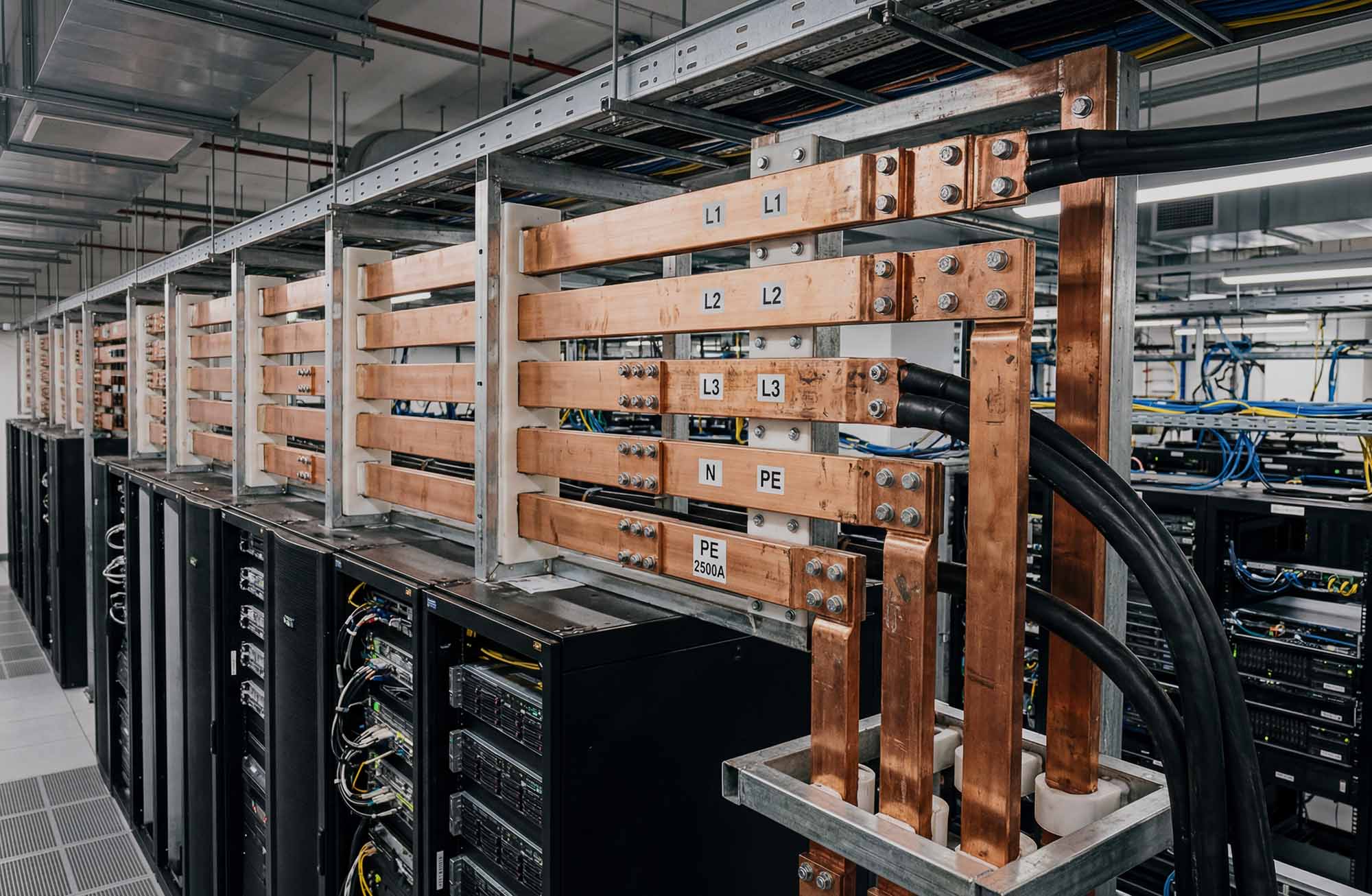
AI infrastructure operates in a different register entirely. A single NVIDIA DGX H100 server, housing eight H100 GPUs each drawing up to 700W under load, consumes approximately 10–11kW per unit. Installing just four of these servers in a single rack brings the total power demand above 40kW. Racks with eight AI servers can readily exceed 60kW. Some emerging configurations, such as NVIDIA's GB200 NVL72 system, push a single rack to 140kW and beyond.
Sources: NVIDIA DGX SuperPOD Data Centre Design Guide; Server Technology, Rack Power Solutions for Modern AI Applications (2026); IntuitionLabs, NVIDIA HGX Platform: Data Centre Physical Requirements Guide (2025)
This represents a 4–10x increase in power density compared to traditional infrastructure, and it breaks conventional distribution systems in several interconnected ways.
Where conventional systems fail
Cable-based distribution that works adequately at 5–10kW per rack breaks down at AI-scale densities in several distinct ways:
- Space and airflow: The number and size of conductors required to carry 40–60kW loads consumes valuable floor and plenum space and restricts the airflow that cooling systems depend on.
- Mutual heating: Bundled high-current cables generate heat that raises the temperature of adjacent conductors, requiring significant de-rating of current-carrying capacity. What starts as a conductivity problem quickly becomes a thermal one.
- Connection integrity: Even marginal increases in resistance at joints or terminals generate disproportionate heat through I²R losses at these current levels. A connection that performs acceptably at 200A may be a thermal liability at 1,000A, creating hot spots that compromise both electrical safety and reliability.
- Facility capacity: In many existing buildings, the total power capacity cannot support more than a handful of high-density AI racks without utility upgrades that typically take 18–24 months to complete.
The consequences are well documented in practice: circuit breakers trip under unexpected loads, transformers overheat, and PDUs fail under currents they were never designed to handle.
Source: Introl, 40–250kW Racks: Extreme Density Cooling Solutions (September 2025)
The compounding challenge
High-current electrical distribution for AI does not operate in isolation from the rest of the facility. Every watt lost to resistance in distribution systems becomes heat that cooling infrastructure must remove, and cooling systems themselves consume power. Inefficient distribution therefore creates a compounding burden: higher electrical losses mean greater cooling demand, which means higher total facility energy consumption. As we explore in our article on Copper Heat Exchangers and Thermal Management in Data Centre Cooling Systems, the relationship between electrical efficiency and cooling load is direct and economically significant. Getting electrical distribution right from the outset reduces both operational costs and infrastructure complexity throughout the facility's life.
Copper's Unique Suitability for High-Current AI Infrastructure
Electrical performance at extreme scale
Copper's electrical conductivity exceeds aluminium's by approximately 60%. At modest current levels, this difference is meaningful. At AI-scale current levels, running into hundreds to thousands of amperes per distribution path, it is decisive. Lower resistance means lower I²R losses, which means less heat generated per ampere of current carried, which means smaller conductors can carry equivalent loads safely, or larger conductors can carry higher currents within acceptable thermal limits.
For a given current requirement, copper busbars achieve lower resistance than aluminium alternatives of equivalent cross-section. This is not just an efficiency gain; it directly determines whether a distribution system can meet its rated current capacity without exceeding safe operating temperatures under continuous AI workloads.
Thermal management at current extremes
Copper's thermal conductivity of approximately 400 W/m·K substantially exceeds aluminium at approximately 230 W/m·K. In AI infrastructure, where high-current distribution systems generate continuous and substantial heat loads, this advantage becomes critical. Copper busbars distribute generated heat more evenly along their length, preventing localised hot spots at connection points and high-load segments. Their geometry, typically large flat surfaces, facilitates effective heat dissipation through natural convection, helping maintain safe operating temperatures even under the sustained maximum loads that AI workloads impose.
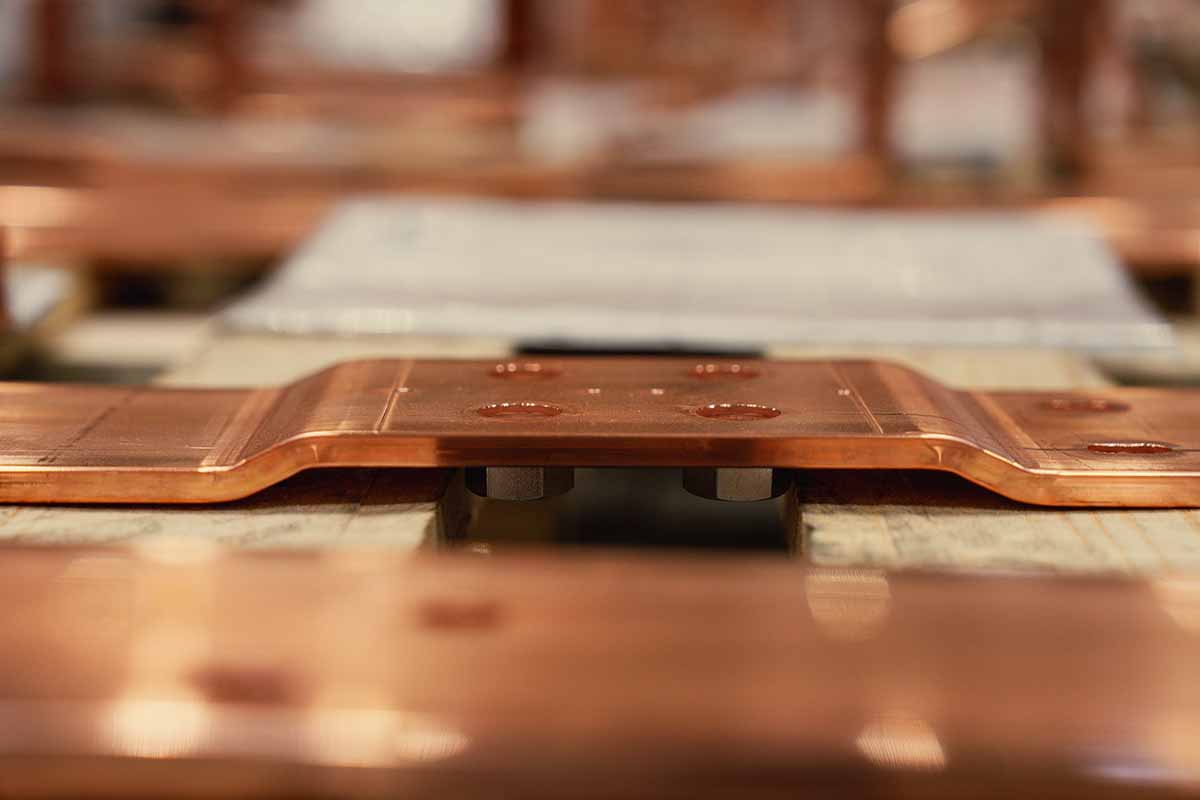
As discussed in greater detail in our article on Copper Busbars in Data Centres, a 2,000A busbar with 0.05 milliohms resistance per metre generates approximately 200W of heat per metre. In a high-density AI facility with extended distribution runs, thermal management of the electrical system itself becomes a significant engineering consideration, and one that copper's material properties address more effectively than any available alternative.
Mechanical reliability under continuous high-load operation
AI workloads are not intermittent. GPU clusters run continuously for weeks or months during training runs. Data centre power distribution infrastructure must maintain reliable performance under sustained maximum load conditions, subject to repeated thermal cycling as workloads vary. Copper's coefficient of thermal expansion closely matches that of most connection hardware materials, minimising differential expansion that can loosen connections over time. Properly torqued copper connections maintain their integrity through thousands of thermal cycles, a critical characteristic given that connection failure in an AI cluster can halt an entire distributed training job across hundreds of GPUs simultaneously.
Corrosion resistance adds to long-term reliability. Copper naturally forms a protective oxide layer that inhibits further degradation in data centre environments, and surface treatments, such as tin, silver or nickel plating, provide additional protection where operating conditions demand it. Properly specified and installed copper distribution systems routinely deliver 25–30 years of reliable service life.
MSS International's Copper Solutions for AI Infrastructure
Material specification: why ETP copper matters at high currents
At MSS International, our busbar and conductor systems are manufactured from Electrolytic Tough Pitch (ETP) copper, a material specified for its exceptional purity of 99.9% copper minimum, and the correspondingly high electrical and thermal conductivity that purity delivers. At AI-scale currents, material quality is not a detail. Even minor variations in conductivity translate directly to differences in heat generation, voltage drop, and system efficiency at scale.
Our precision manufacturing processes ensure reliable forming and shaping without introducing surface damage or work hardening that could affect conductivity or create stress concentration points. Each copper delivery from certified suppliers undergoes verification testing before entering production, confirming conductivity through standardised testing procedures and providing full material traceability.
Simulation-validated engineering for demanding deployments
MSS International's busbar systems are validated through advanced heat and electrical resistance simulations before manufacturing begins. For AI infrastructure applications, where power densities, current levels and thermal loads represent some of the most demanding conditions in the electrical distribution sector, this simulation-led approach is essential. It enables our engineering team to identify potential issues during the design phase, optimise conductor geometry and surface area for effective heat dissipation, and confirm that configurations will maintain safe operating temperatures under real-world maximum load conditions.
This validation capability is particularly important when working on custom assemblies for hyperscale deployments, where standard configurations may not address the specific architectural, current density, and operational requirements of the facility in question.
Custom assemblies for hyperscale facilities
Hyperscale AI facilities rarely conform to standard configurations. The architecture of a purpose-built AI data centre, with its high-density GPU clusters, complex power distribution topology, integration of liquid cooling systems, and specific requirements for redundancy and maintainability, demands bespoke engineering rather than off-the-shelf components.
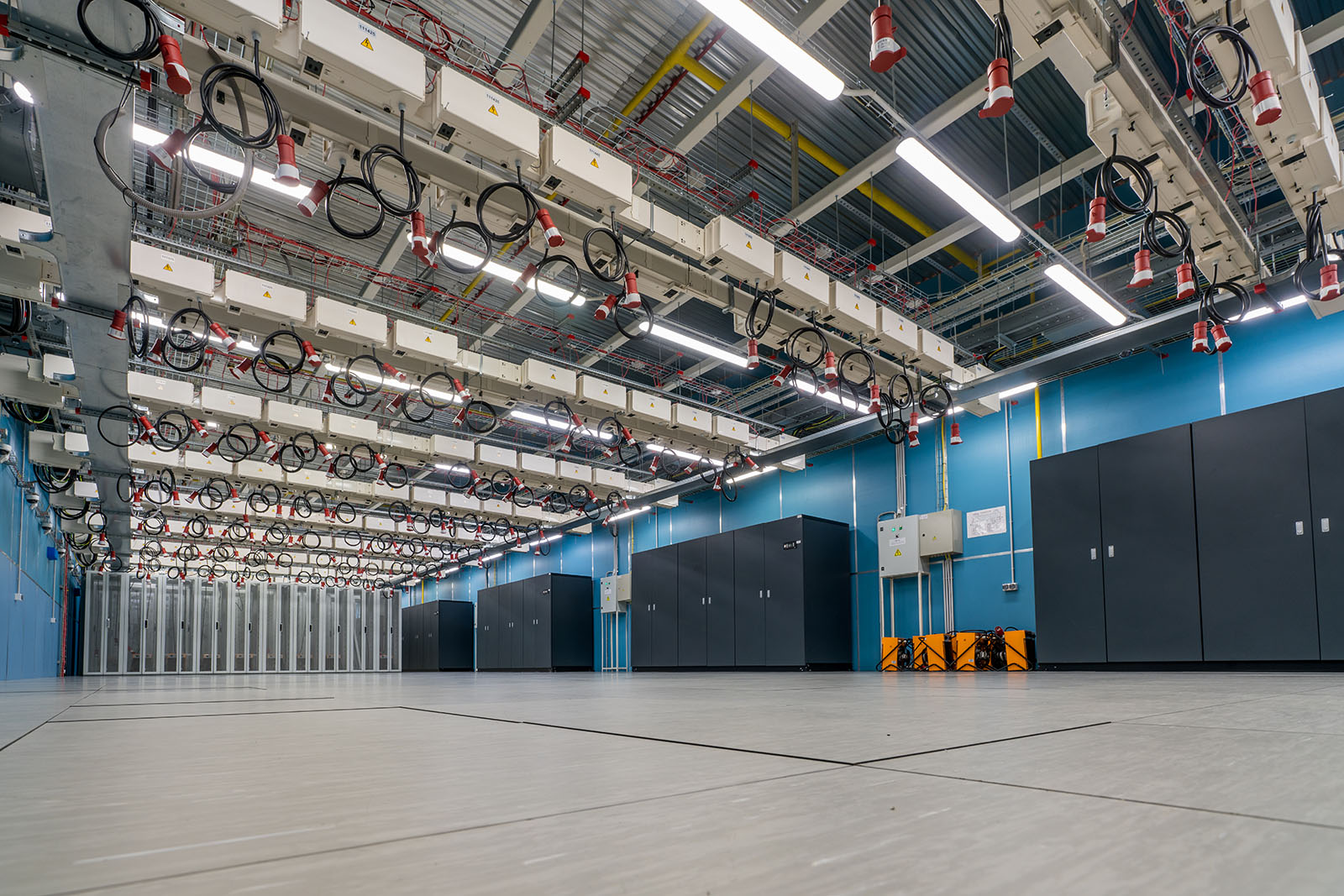
MSS International's engineering team works closely with customers from initial design through to final installation. Our process begins with thorough requirements analysis: understanding not just electrical specifications (current capacity, voltage, phasing, redundancy topology) but also installation environment, available routing paths, future expansion plans, and any specific constraints including seismic requirements or standards compliance obligations. Computer-aided design tools enable rapid iteration and three-dimensional visualisation, ensuring busbar assemblies integrate cleanly with surrounding infrastructure before manufacturing begins.
Our CNC machining capabilities produce complex busbar geometries with the tight tolerances that connection integrity and thermal performance demand. Multi-axis machining centres execute drilling, milling, and profiling operations that create custom connection points, mounting arrangements, and geometries specific to each installation. Forming operations shape copper stock with precision press brakes that avoid work hardening or surface damage that might compromise conductivity or introduce fatigue points.
Quality assurance and certification
Every busbar system shipped by MSS International is supported by our quality management systems, certified to ISO 9001 and IATF 16949. Comprehensive test protocols cover each stage of performance validation:
- Four-wire resistance measurement — confirms electrical conductivity and verifies material quality against specification
- Thermal cycling — subjects assemblies to repeated heating and cooling cycles simulating years of operational load variation
- Mechanical load testing — validates structural capability under installation and operational stresses
- High-potential (hipot) testing — verifies insulation systems withstand voltage levels significantly above normal operating conditions
Certification packages provide customers with complete traceability and documented confidence in product quality, important not only for commissioning but for the ongoing operational assurance that mission-critical AI infrastructure demands.
Future-Proofing Data Centre Electrical Infrastructure
Power densities will keep rising
The trajectory of AI hardware development points clearly toward continued increases in per-rack power demand. Each successive GPU generation has delivered more computational performance, typically accompanied by higher power consumption per unit. NVIDIA's H100 draws up to 700W per GPU. Its successor architectures push beyond that. The GB200 NVL72 system already targets 140kW per rack. Industry engineers are designing for 100kW+ per rack as a near-term operational reality, with longer-term projections pointing higher still.
Sources: IntuitionLabs, NVIDIA HGX Platform: Data Centre Physical Requirements Guide (2025); Syaala, The Engineering Behind 40kW GPU Racks (January 2026)
Facilities designed to today's maximum requirements may be constrained by tomorrow's hardware. The decisions made during initial infrastructure specification have long-term implications, which is why forward-looking design matters as much as meeting present-day requirements.
Designing for growth: the case for capacity headroom
Oversizing busbar and conductor systems by 25–50% above initial requirements during the first installation represents modest incremental material cost compared to the alternative: retrofitting larger conductors into an occupied, operating facility. Each phase of a retrofit demands careful coordination to avoid service disruption, often requires work during limited maintenance windows, and carries the operational risk of a live high-current distribution environment. The economics strongly favour building in capacity headroom from the outset.
Modular busbar architectures specifically support future growth. Tap-off flexibility allows additional power access points to be added at any location along a busbar run without major infrastructure modification, a capability that becomes particularly valuable as rack layouts evolve and power requirements increase with successive hardware generations.
Integration with liquid cooling infrastructure
The extreme power densities of leading-edge AI workloads are accelerating adoption of liquid cooling technologies: direct-to-chip systems, rear-door heat exchangers and immersion cooling. These approaches require careful integration with electrical distribution infrastructure. Busbar systems designed for AI facilities must account for the physical presence of cooling manifolds, the weight of coolant distribution pipework, and the specific airflow and access constraints of liquid-cooled rack environments. MSS International's DC-specific busbar solutions are engineered with this integration requirement in mind, supporting the transition to liquid-cooled high-density deployments without compromising the electrical performance or reliability that AI operations demand.
Sustainability in High-Current Copper Systems
Sustainability in data centre infrastructure is most credibly measured by operational outcomes rather than materials declarations. In high-current distribution, copper delivers sustainability benefits that are direct and quantifiable.
More efficient copper distribution components generate less waste heat per ampere of current carried. Every reduction in distribution losses reduces both direct electrical consumption and the cooling capacity required to manage the resulting heat. In large-scale AI facilities operating continuously, these compounding efficiency gains are substantial. The relationship is straightforward: better electrical efficiency means lower total facility energy consumption and a smaller operational carbon footprint.
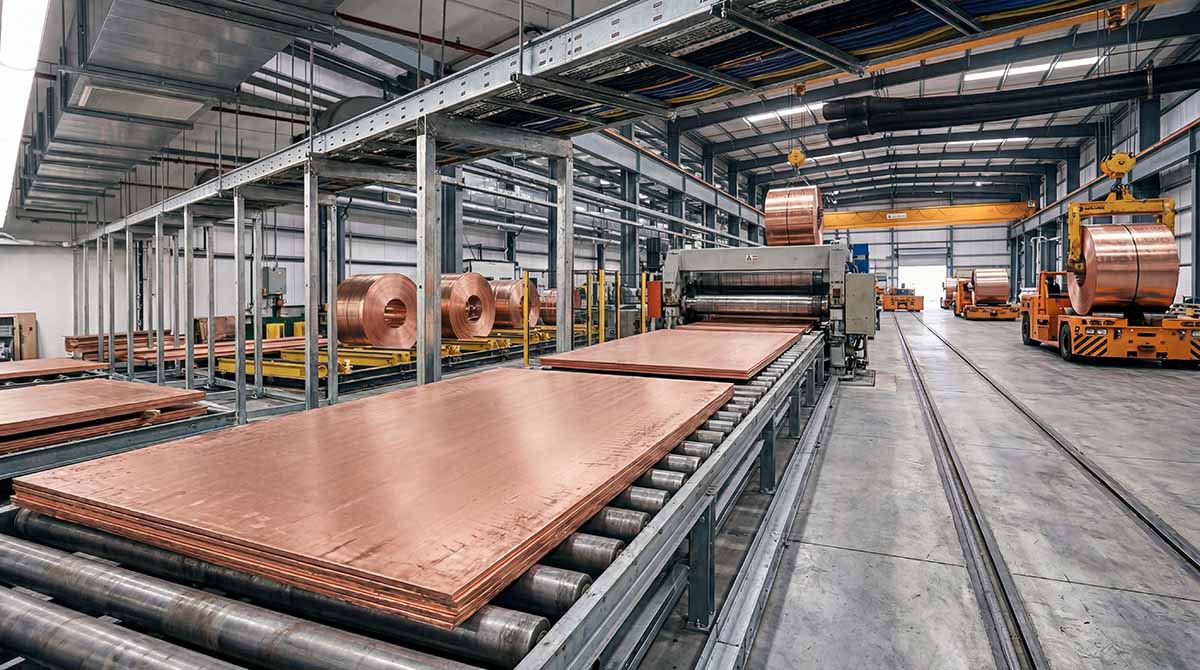
Copper's recyclability without performance degradation makes it one of the most genuinely circular materials in industrial use. At MSS International, we work continuously with copper refiners to maximise recycled content in our manufacturing while maintaining the purity standards that electrical applications demand. Our scrap purchase services support a closed-loop approach for data centre operators: retired components and replacement parts are recovered, processed back to high-purity copper, and returned to production for new components. Recycled copper production requires approximately 85% less energy than primary production from ore, avoiding approximately 2.5 tonnes of CO² per tonne of recycled copper compared to virgin material.
The long service life of properly specified and installed copper busbar systems, typically 25 to 30 years in service, further reduces the material and energy cost associated with replacement over a facility's operational lifetime. Investing in quality at the specification stage is, in practical terms, the most sustainable approach available.
Our manufacturing facilities utilise 25% renewable energy, with ongoing efforts to increase this percentage as part of our broader commitment to sustainable operations.
Conclusion: Copper as the Foundation of AI-Ready Infrastructure
AI infrastructure represents the most demanding electrical distribution environment that data centre designers and operators have ever had to address. The power densities, current levels, thermal loads, and reliability requirements of GPU-intensive AI facilities push conventional approaches to, and in many cases beyond, their practical limits.
Copper's combination of exceptional electrical conductivity, superior thermal performance, proven mechanical reliability, and long service life makes it uniquely suited to meeting these demands. For high-current AI infrastructure, copper is not one option among many; it is the engineering foundation on which reliable, efficient, and future-ready power distribution is built.
At MSS International, our precision manufacturing of copper busbar systems and custom assemblies draws on over 50 years of experience in demanding electrical distribution applications. Our simulation-validated engineering approach, ETP copper material specification, ISO 9001 and IATF 16949 certified quality systems, and capability for bespoke custom assemblies ensure our components perform reliably under the continuous extreme loads that AI facilities impose, today and as those loads continue to grow.
Ready to discuss your AI data centre infrastructure requirements? Contact MSS International to explore how our precision-engineered copper busbar systems and custom assemblies can support your facility's high-current power distribution needs, from initial design through to long-term operational performance.
Further reading:
- For a comprehensive overview of copper's role across all data centre systems, see our pillar article on The Essential Role of Copper in Modern Data Centre Infrastructure.
- For detail on copper busbar design and thermal management in power distribution, see Copper Busbars in Data Centres: Optimising Power Distribution for High-Density Operations
- and Copper Heat Exchangers and Thermal Management in Data Centre Cooling Systems.
Further reading:
- For a comprehensive overview of copper's role across all data centre systems, see our pillar article on The Essential Role of Copper in Modern Data Centre Infrastructure.
- For a look at what mission-critical actually means, see Ensuring Data Centre Uptime.
- For detail on power distribution busbar design, see Copper Busbars in Data Centres: Optimising Power Distribution for High-Density Operations.
- For the thermal management challenge facing modern data centres see: Copper Heat Exchangers and Thermal Management.
Frequently Asked Questions
How do copper components handle the thermal loads generated by high-current AI systems?
Copper's thermal conductivity of approximately 400 W/m·K allows it to conduct heat away from high-resistance connection points and distribute it along conductor lengths, where large surface areas dissipate it through natural convection. MSS International validates busbar designs through advanced thermal simulation before manufacturing, confirming that surface area, geometry, and conductor cross-section combine to maintain safe operating temperatures under sustained maximum AI workloads. Where facility conditions require additional thermal management, surface treatments and conductor arrangements can be optimised for specific installation environments.
How does MSS International test and certify copper components for high-current applications?
Our quality assurance processes include four-wire resistance measurements confirming conductivity and material quality, thermal cycling tests simulating years of operational load variation, mechanical load testing validating structural capability, and high-potential (hipot) testing verifying insulation performance. All testing and validation is documented under our ISO 9001 and IATF 16949 certified quality management systems, with comprehensive certification packages shipped with every order providing full traceability. For AI infrastructure applications with specific standards compliance requirements, our engineering team can advise on test protocols appropriate to those obligations.
How should facilities plan for future power density increases when specifying copper components today?
The most cost-effective approach is to oversize busbar and conductor systems by 25–50% above initial requirements during first installation. The incremental material cost is modest relative to the cost of retrofitting larger conductors into an operational facility later. Modular busbar architectures that support tap-off additions at any point along a run provide additional flexibility as rack layouts and power requirements evolve. MSS International's engineering team can advise on specific capacity headroom and modular design approaches appropriate to each facility's growth projections.
What current levels do AI data centre racks actually require?
Current-generation AI racks drawing 40–60kW at standard data centre voltages (typically 415V three-phase) require distribution currents in the range of 60–90A per phase at the rack level, with upstream distribution paths carrying proportionally higher currents as multiple racks are served from common busbars. Emerging ultra-high-density configurations drawing 100kW or more per rack push these requirements further. MSS International's engineering team assists customers with accurate current sizing analysis specific to their facility topology and equipment configuration.
What is the difference between standard and custom copper assemblies for hyperscale AI deployments?
Standard busbar configurations serve many applications effectively, but hyperscale AI facilities typically require custom designs that address specific current densities, physical routing constraints, connection topology, redundancy architecture, and integration with liquid cooling infrastructure. MSS International's custom engineering process begins with a thorough requirements analysis covering electrical specifications, installation environment, future expansion plans, and any applicable standards compliance obligations. CAD modelling enables design validation before manufacturing begins, ensuring fit and performance in complex facility environments where standard off-the-shelf components would require compromise.


