 UK (English)

A component that fails in the field does not just create a cost problem. In power distribution, renewable energy infrastructure, industrial switchgear, and electrification applications, a single non-conforming part can trigger unplanned downtime, costly rework, and damage to your reputation with your own customers. The higher the stakes of the application, the higher the cost of getting supplier quality wrong.
This is why quality assurance in component manufacturing deserves to be treated as a strategic consideration, not a background assumption. Yet quality is one of the most overused and least scrutinised claims in manufacturing procurement. Almost every supplier will tell you they take quality seriously. Far fewer can demonstrate the systems, processes, and certifications that actually back that claim up.
In this article, we look at what quality assurance genuinely means in the context of component manufacturing, the best practices that distinguish rigorous manufacturers from the rest, and the tangible benefits that flow from getting it right. We will also show how MSS International approaches quality across our manufacturing operations.
Here is what we will cover:
- The difference between quality assurance and quality control, and why it matters
- The industry pressures driving higher QA standards across component manufacturing
- The best practices that define a genuinely quality-driven manufacturer
- The role of vertical integration in achieving consistent quality outcomes
- QA considerations specific to the materials used in electrical assemblies
- The real-world benefits of strong QA for procurement managers and engineers
- How MSS International embeds quality across our operations
What quality assurance actually means in component manufacturing
The terms quality assurance and quality control are often used interchangeably, but the distinction between them is important - particularly when you are evaluating a manufacturing partner.
Quality control is inspection: measuring, testing, and checking finished components against a specification. It identifies problems after they have occurred. Quality assurance is the system built around preventing those problems from arising in the first place. It encompasses the processes, controls, standards, training, and documentation that govern how a manufacturer operates at every stage of production.
A manufacturer who relies primarily on final inspection is a fundamentally higher-risk partner than one with QA embedded throughout their process. By the time a defect is caught at the end of a production run, material and labour have already been consumed. In complex multi-process assemblies - where components pass through forging, machining, finishing, and assembly stages - a defect introduced early and not caught until the end can mean scrapping significant amounts of work. Worse, if it is not caught at all, it reaches your project.
The shift from reactive quality control to proactive quality assurance is the hallmark of a mature manufacturing operation. It is also one of the clearest signals of a supplier worth trusting with bespoke, technically demanding work.
The industry pressures driving higher QA standards
The bar for quality in component manufacturing has been rising steadily, driven by a combination of regulatory, commercial, and technical forces.
Tightening regulatory and standards requirements
Internationally recognised management systems such as ISO 9001 have long provided a baseline framework for quality in manufacturing. But customer and regulatory expectations are increasingly moving beyond baseline compliance. In sectors such as renewable energy, EV infrastructure, and industrial power systems, supply chain quality documentation, traceability requirements, and audit readiness are now standard procurement requirements rather than differentiators.
The EU's Ecodesign for Sustainable Products Regulation (ESPR), which entered into force in July 2024, is also expanding the information and documentation obligations placed on manufacturers and their supply chains. Traceability, material provenance, and product lifecycle data are increasingly part of the compliance picture.
The complexity of modern assemblies
Many electrical components and assemblies involve multiple interdependent manufacturing stages - hot forging, CNC machining, stamping, bending, lamination, and final assembly. In these multi-step processes, quality at each stage directly affects the integrity of subsequent stages. A dimensional variance introduced during forging, for example, may only manifest as a performance issue after machining and assembly. The complexity of modern assemblies means that point-in-time inspection at the end of a process is no longer a sufficient quality strategy.
The cost of field failures
The commercial case for rigorous QA is compelling. Studies across manufacturing sectors consistently show that the cost of rectifying a defect rises sharply the later it is detected. A non-conformance identified during in-process inspection costs a fraction of one caught at final inspection, which in turn costs a fraction of one that reaches the customer. Field failures - particularly in infrastructure or industrial applications - can involve recall costs, site visits, project delays, and contractual penalties that dwarf the original component cost. Strong upstream QA is not just good engineering practice; it is sound financial risk management.
Customer expectations for traceability and documentation
Procurement managers and engineers in regulated or safety-critical industries increasingly require full material and process traceability as a condition of supply. This means being able to trace a finished component back through every stage of its production - including the source and specification of raw materials, in-process inspection records, and final sign-off documentation. Suppliers who cannot provide this level of documentation represent a compliance risk to their customers.
Best practices in component manufacturing QA
The following practices distinguish manufacturers with genuinely embedded quality systems from those who treat QA as a formality.
- Certified quality management systems: ISO 9001 is the internationally recognised baseline for quality management. Certification is not self-declared - it requires independent audit by an accredited third party and ongoing surveillance to maintain. A supplier holding ISO 9001 across their key manufacturing sites has demonstrated that their quality systems are subject to external scrutiny. Certification alone is not sufficient, but its absence should give any procurement manager pause.
- Process control at every stage: Best-in-class manufacturers do not wait until the end of a production run to check quality. Inspection and control points are built into every significant stage of the manufacturing process - dimensional checks after forming, surface finish inspection after machining, functional testing before final assembly. The goal is to catch and contain non-conformances as early as possible, before defective parts progress further through the production sequence.
- Material traceability: Rigorous QA begins before manufacturing starts, with incoming inspection and traceability of raw materials. This means verifying that materials meet the specified grade, dimensions, and mechanical properties, and maintaining documented records that link each batch of finished components back to the raw material from which they were made. In regulated industries, this traceability chain is not optional.
- In-process inspection and statistical process control: Statistical process control (SPC) uses measurement data gathered during production to monitor process stability and detect trends before they result in non-conforming output. Rather than simply accepting or rejecting finished parts, SPC provides early warning when a process is drifting out of control - allowing intervention before defects are produced. For high-volume or tight-tolerance work, it is a mark of a genuinely sophisticated quality operation.
- Tooling and equipment calibration: The accuracy of any inspection activity is only as reliable as the equipment used to perform it. Best-practice manufacturers maintain formal calibration programmes for all measurement and test equipment, with documented records and defined recalibration intervals. This is the foundation on which trustworthy inspection results depend.
- Non-conformance management and corrective action: What distinguishes strong quality systems is not the absence of problems but the rigour with which they are investigated and resolved. Effective non-conformance management involves documenting every deviation, conducting root cause analysis, implementing corrective actions, and verifying their effectiveness. This closed-loop approach prevents recurrence and drives genuine continuous improvement over time.
- Documentation and audit trails: Quality documentation is the evidence base that underpins every other QA practice - inspection records, material certificates, calibration logs, non-conformance reports, and corrective action records. A supplier who can provide complete, well-organised documentation at any point in a component's lifecycle is one who has their quality systems under genuine control.
The role of vertical integration in quality outcomes
One of the most significant but least discussed factors in manufacturing quality is the degree to which a supplier controls their own production process.
A vertically integrated manufacturer - one who handles design support, raw material procurement, forming, machining, finishing, and assembly within their own facilities - has direct control over quality at every stage. They set the standards, they perform the inspections, and they are accountable for the outcome across the full process.
A manufacturer who subcontracts significant portions of their production introduces handoff points at which quality control becomes more difficult to enforce. Each subcontractor brings their own processes, standards, and inspection practices - or lack thereof. Material can be mishandled in transit between sites. Traceability chains become harder to maintain. And when something goes wrong, accountability becomes fragmented.
For bespoke electrical assemblies, where tight tolerances and consistent material properties are critical, the quality advantages of vertical integration are substantial. Fewer handoffs mean fewer opportunities for error, contamination, or specification drift. They also mean faster response when issues do arise, since the manufacturer has direct visibility and control over every stage of the process rather than having to manage a chain of subcontractors.
QA considerations for electrical assembly materials
The materials used in electrical assemblies - high-conductivity copper, brass, lead alloys, and other precision-engineered metals - carry their own specific quality requirements that demand expertise and rigour throughout the supply chain.
Conductivity and alloy specification
For copper busbars, connectors, and contact assemblies, electrical conductivity is a primary performance parameter. Conductivity is directly affected by alloy composition and purity. Incoming materials must be verified against the correct specification, and processing conditions must be controlled to avoid contamination or microstructural changes that could degrade performance.
Dimensional precision
Electrical assemblies frequently involve close-fitting mating components where dimensional accuracy directly affects contact resistance, mechanical strength, and assembly integrity. Tolerances in the order of tens of microns are common, placing significant demands on both the machining process and the inspection equipment used to verify it.
Surface finish
Contact surfaces in electrical assemblies must meet specific surface finish requirements to ensure reliable electrical contact and, where applicable, accept platings or coatings consistently. Surface finish is affected by machining parameters, tooling condition, and handling - all of which must be controlled within a robust QA system.
Recycled material quality
Using recycled metals - such as recycled brass or lead - is both an environmental and a commercial benefit, but it introduces an additional QA consideration: ensuring that recycled feedstocks meet the same specifications as virgin material. This requires rigorous incoming inspection and supplier qualification processes for materials sourcing.
How strong QA translates into real-world benefits
Investing in a manufacturer with robust quality assurance systems delivers tangible, measurable benefits across the lifecycle of a project. For procurement managers and engineers, the case breaks down as follows:
- Reduced risk of field failures and unplanned downtime: The most direct benefit of rigorous QA is components that perform reliably in service. In applications where downtime carries significant operational or financial cost - power distribution infrastructure, industrial plant, renewable energy systems - reliability is not a convenience; it is a core requirement.
- Fewer rework cycles and faster project delivery: Non-conforming components disrupt schedules. A supplier who catches issues in-process protects your timeline; one who prevents issues from arising at all accelerates it. The cumulative effect of strong upstream QA on delivery performance is significant.
- Simplified compliance and audit readiness: A supplier with comprehensive documentation and a certified quality management system reduces the compliance burden on your team considerably. Material certificates, inspection records, and traceability documentation are available on demand rather than having to be chased down under pressure.
- Lower total cost of ownership: A higher-QA supplier may carry a slightly higher unit price than a lower-cost alternative with weaker controls. But when total cost of ownership is considered - field failures, rework, project delays, warranty claims - the economics consistently favour the more rigorous option. The question is not what the component costs; it is what a failure costs.
- Stronger, more strategic supplier relationships: Consistent, documented quality performance builds the kind of confidence that allows supply relationships to deepen over time. Procurement teams who can rely on a supplier's quality output spend less time managing exceptions and more time on work that adds value.
How MSS International approaches quality assurance
Quality assurance is not a department at MSS International - it is a discipline embedded across our manufacturing operations in the UK, Poland, and India.
Certified quality management systems
Our manufacturing operations are certified to ISO 9001, providing the structured framework within which our quality processes operate. This certification is maintained through regular independent audit and is not a one-time achievement but an ongoing commitment to the standards it represents. We also hold ISO 14001 environmental management and ISO 45001 health and safety certifications across our key sites, reflecting a broader culture of managed, audited operational discipline.
In-house process control across the full manufacturing sequence
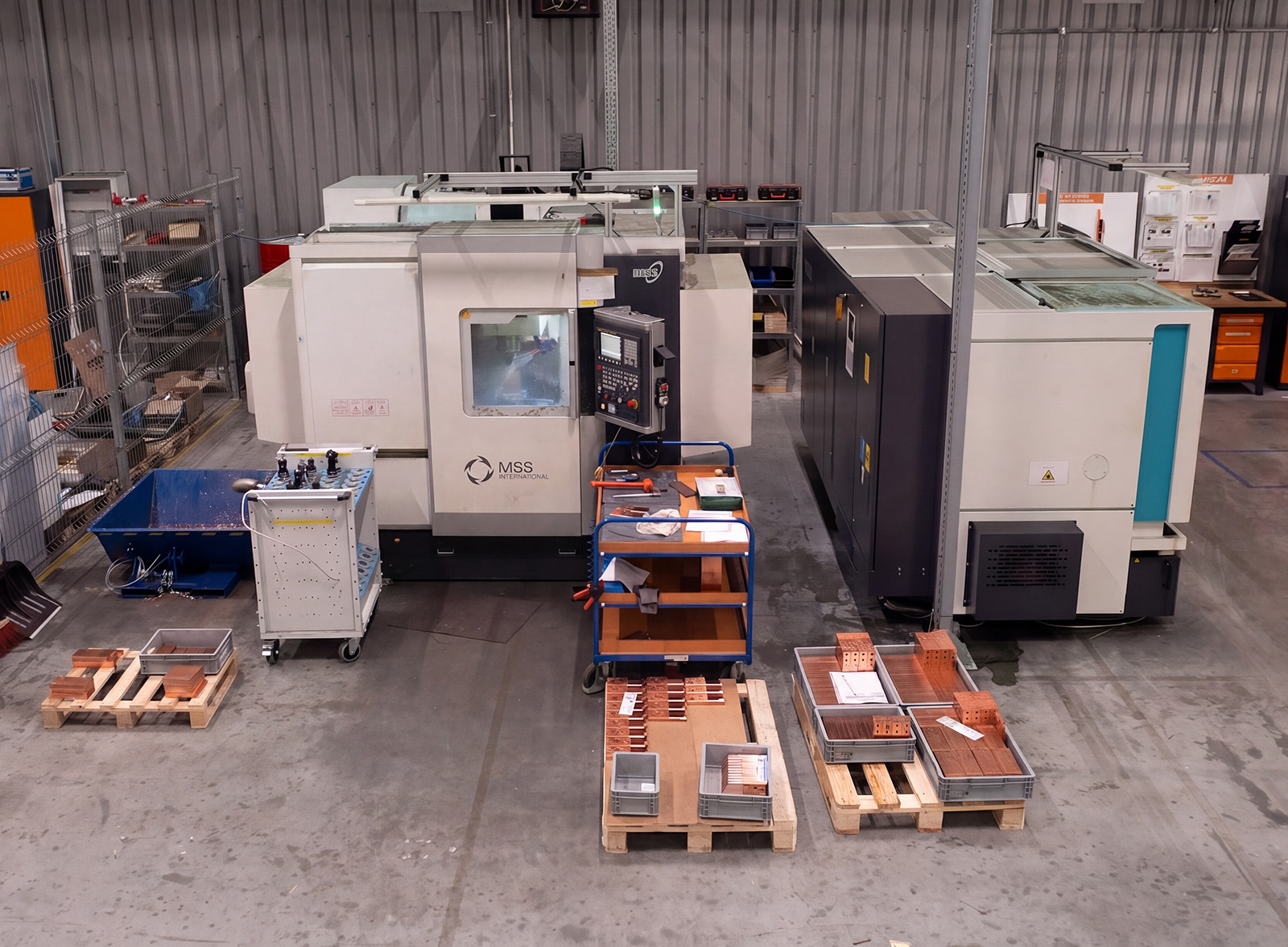
Our vertically integrated model means that forging, CNC and VMC precision machining, copper stamping, punching, bending, laminations, and final assembly all take place within our own facilities. We do not rely on subcontractors for these processes - which means we control quality standards at every stage and maintain direct accountability for the finished assembly. Inspection and control points are built into the production sequence, not added as an afterthought at the end.
Materials expertise and traceability
We have deep expertise in the materials central to electrical assembly manufacturing, including high-conductivity copper, brass, and lead alloys. Our supply chain uses 90% recycled lead and 100% recycled brass - and we apply the same incoming inspection rigour to recycled feedstocks as to virgin materials, ensuring that sustainability and quality are not in tension. Full material traceability is maintained from raw material through to finished component, providing our customers with the documentation they need for compliance and audit purposes.
Rigorous inspection and documentation
Our ISO-certified systems underpin a comprehensive inspection and documentation process across all manufacturing stages. Measurement and test equipment is maintained under formal calibration programmes, and non-conformance management processes ensure that any deviations are investigated, resolved, and used to drive continuous improvement. Customers receive full quality documentation as standard.
A commitment to continuous improvement
ISO 9001 is built around the principle of continual improvement, and we take that seriously. Our quality data is used actively to identify process trends, address root causes, and raise performance standards over time - not simply to demonstrate compliance at the point of audit.
Conclusion
Quality assurance in component manufacturing is not a cost of doing business - it is a competitive advantage for the customers who demand it and the manufacturers who deliver it. The difference between a supplier with embedded QA and one who relies on end-of-line inspection is the difference between a partner who protects your project and one who introduces risk into it.
The best practices outlined in this article - certified management systems, process control at every stage, material traceability, calibrated inspection, rigorous non-conformance management, and comprehensive documentation - are the markers of a manufacturer genuinely equipped to supply bespoke, technically demanding electrical assemblies to the standards that modern applications require.
At MSS International, these are not aspirational commitments. They are the operational foundation on which our manufacturing is built.
Get in touch
If you would like to discuss your quality requirements, request documentation, or explore how MSS International's capabilities can support your next project, contact our team today.


